DJI Mini 3 review: the best value pick

The DJI Mini 3 is the value pick that quietly does most of what the pricier Mini 4 Pro does. The same sensor, the same sub-250 g weight and an even longer battery, for a good deal less money. Here is what you keep, what you give up, and who it suits.

Transparency: This article contains affiliate links. If you buy through one of them, we may earn a commission, at no extra cost to you. That is how we fund our testing and keep this site independent. More about how we test.

Contents

It is easy to assume the cheaper drone in a lineup is the compromised one, but the Mini 3 is more interesting than that. It shares the Mini 4 Pro's 1/1.3 inch sensor, so in the right conditions the footage is hard to tell apart, and it actually edges ahead on flight time. What you sacrifice is the obstacle sensing and the 60fps mode, and for many pilots that is a sacrifice well worth making. That is exactly why it is our best value choice.

Specifications

Model Price CameraWeightFlight time Rating Link
DJI Mini 3 Camera Drone ★ Top pick DJI Mini 3 Camera Drone £439.00 4K/30fps, 1/1.3" sensorUnder 250 g (no registration to fly)~38 min (up to ~51 min Plus battery) ★ 4.5 View →
★ Top pick
DJI Mini 3 Camera Drone £439.00
Camera : 4K/30fps, 1/1.3" sensorWeight : Under 250 g (no registration to fly)Flight time : ~38 min (up to ~51 min Plus battery) ★ 4.5/5
View on Amazon →

Our in-depth review

BEST VALUE
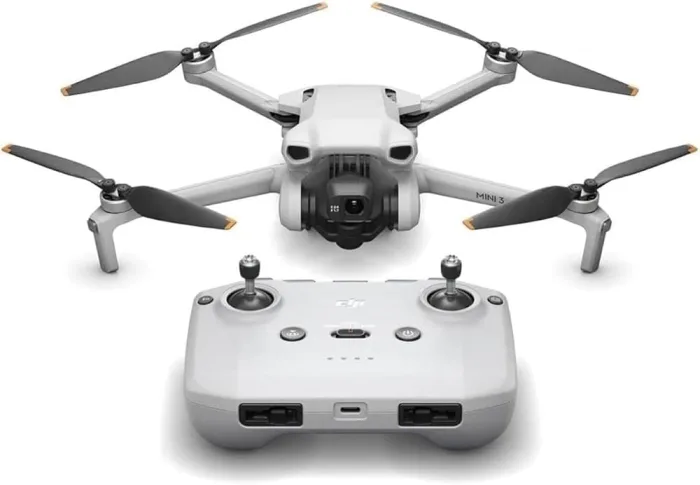
DJI Mini 3 Camera Drone - drone DJI

DJI Mini 3 Camera Drone

4.5/5

£439.00

4K/30fps, 1/1.3" sensor · Under 250 g (no registration to fly) · ~38 min (up to ~51 min Plus battery)

  • Same sensor size as the Mini 4 Pro for less money
  • Stays under 250 g
  • Very long flight time
  • True vertical video for social clips
  • No obstacle avoidance, so it asks for more care
  • 4K is capped at 30fps
Camera 4/5
Flight time 5/5
Ease of flight 4/5
View on Amazon →

The verdict from Henry Watts, drone tester and licensed pilot

Our best value pick. The DJI Mini 3 gives you most of what makes the Mini 4 Pro great — the sub-250 g weight, a 1/1.3" sensor and crisp 4K — for noticeably less. What you lose is the obstacle sensing and the 60fps mode, so it rewards a slightly more careful pilot. For the buyer who wants DJI image quality without the Pro price, it is the rational choice.

The footage is hard to tell apart from the Pro in good light; you just fly with a little more care.

Who is the DJI Mini 3 for?

The Mini 3 is the right drone for the value-minded buyer who wants DJI image quality without paying the Pro premium. If you fly mostly in open spaces, beaches, fields and parks, where there is little to collide with, you will rarely miss the obstacle avoidance, and you pocket the saving. Its sub-250 g weight keeps the rules simple (an operator ID, no flyer test), and the long battery makes for relaxed, unhurried flying.

It is less ideal for nervous beginners who want a safety net near obstacles, or for anyone who plans to fly close to trees and buildings, where the Mini 4 Pro's all-round sensing genuinely earns its keep. It is also not for the videographer who needs 4K at 60fps. For a careful pilot after great stills and smooth 30fps video on a budget, though, it is the smart buy.

How the DJI Mini 3 performs

Camera

The Mini 3 uses the same large 1/1.3 inch sensor as the Mini 4 Pro on a 3-axis mechanical gimbal, and it shows. In good light the 4K footage is crisp and clean, the colours are pleasing, and the larger sensor holds up well as the light fades. It also shoots true vertical video for social clips. The one real limit is that 4K is capped at 30fps rather than 60, so very fast, smooth motion is slightly less fluid, but for the vast majority of shots the difference is academic.

Flight time

This is where the Mini 3 surprises. It manages around 38 minutes on the standard battery and up to roughly 51 minutes with the Plus battery, which is actually longer than the Mini 4 Pro. For a budget-leaning drone, that is exceptional, and it means fewer interruptions and more time in the air per outing. Real-world figures drop with wind and active flying, as always, but the headline endurance is a genuine strength.

Flying without obstacle sensing

The Mini 3 has downward sensors for steady hovering and clean landings, and it holds its position reliably on GPS, but it has no forward or all-round obstacle avoidance. In practice that simply means flying with a little more awareness: keep it in clear sight and avoid threading it between obstacles. In open spaces this is a non-issue; the trade-off only bites if you regularly fly in tight, cluttered environments.

Build and app

You get the same compact, well-made folding design and the same excellent DJI Fly app as the rest of the range. Nothing about the experience feels budget once you are flying; the savings come from the feature set, not the build quality.

The honest downside: no safety net near obstacles

The Mini 3's main compromise is the absence of obstacle avoidance, and it is worth being clear-eyed about it. If you are a brand-new pilot, or you know you will fly near trees, buildings and people, the DJI Mini 4 Pro's sensing is a real reassurance and may be worth the extra. The Mini 3 rewards a slightly more disciplined pilot. If that sounds like you, you get the bulk of DJI's quality for less, and if you want a non-DJI alternative at a similar price, the Potensic ATOM is worth a look.
Frequently asked questions

Q
What is the difference between the DJI Mini 3 and Mini 4 Pro?

Both stay under 250 g and share the same 1/1.3 inch sensor, so in good light the image quality is very close. The Mini 4 Pro adds full omnidirectional obstacle avoidance, 4K at 60fps and the newer transmission system; the Mini 3 has no obstacle sensing and caps 4K at 30fps. The Mini 3 is the value buy for careful pilots; the Mini 4 Pro is the safer, more capable upgrade.

Q
Does the DJI Mini 3 need registration in the UK?

Because it has a camera, you need a free operator ID from the CAA, but as it weighs under 250 g you do not need the flyer test or a flyer ID. That makes it one of the simpler camera drones to get flying legally. As always, confirm the current rules with the CAA before your first flight.

Q
Is the lack of obstacle avoidance a problem on the Mini 3?

It means you fly with a little more care. The Mini 3 has downward sensors for landing and holds position well, but it will not stop itself flying into a tree or a wall, so you need to keep it in sight and avoid tight spots. For open fields and beaches that is rarely an issue; near obstacles, the Mini 4 Pro's sensing is genuinely reassuring.

Verdict on the DJI Mini 3

The Mini 3 is our best value pick because it delivers most of the Mini 4 Pro's image quality, plus an even longer battery, for clearly less money. The price you pay is the obstacle avoidance and the 60fps mode, and for a careful pilot flying mostly in open spaces, that is a price well worth paying. If you want the safety net of all-round sensing, spend up to the DJI Mini 4 Pro; if you are an outright beginner or buying for a child, the Ryze Tello is the safer start. For the value-focused buyer who wants serious footage on a sensible budget, the Mini 3 is the rational choice. Check our buying guide before you commit.