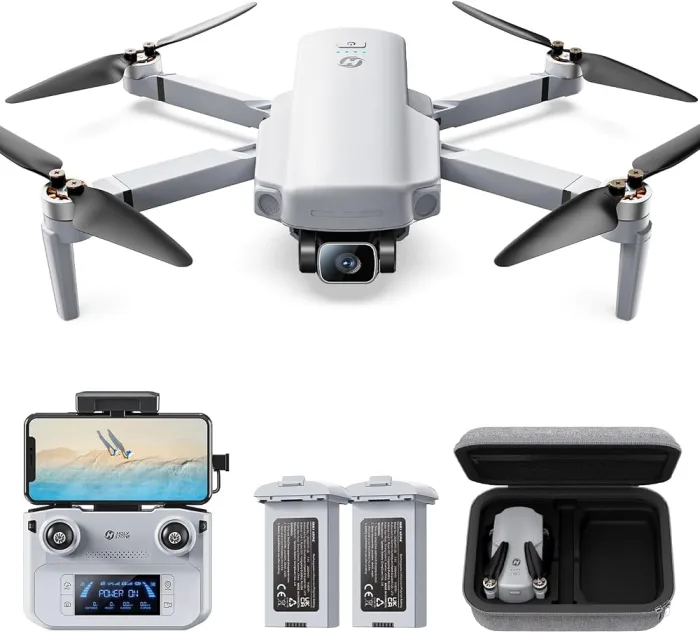
Below the DJI and Potensic price brackets sits a busy world of budget drones, and most of them are forgettable. The Holy Stone HS720E stands out because it gets the fundamentals right: real GPS, return-to-home, a 4K camera and, crucially, two batteries included. It will not match a gimbal drone for smoothness, but as an affordable, capable first GPS drone it punches well above its price, which makes it our best budget pick.
Who is the Holy Stone HS720E for?
The HS720E is for the buyer on a tight budget who still wants a proper GPS drone rather than a basic toy. If you want to capture casual aerial footage, learn to fly with the safety net of return-to-home, and do it for the lowest sensible outlay, it fits the bill. The two included batteries make it especially good value, giving you real flying time out of the box without an immediate extra purchase.
It is the wrong drone if smooth, professional-looking video is your main goal, because the lack of a mechanical gimbal puts a ceiling on footage quality. It is also worth noting that, at around 495 g, it sits in the heavier rules category, so anyone wanting to skip the flyer test should look at a sub-250 g drone like the DJI Mini 3 or Potensic ATOM instead.
How the Holy Stone HS720E performs
Camera and stabilisation
The HS720E records 4K and uses electronic image stabilisation rather than a mechanical gimbal. EIS steadies footage in software by cropping the frame, which works well enough for casual clips but produces visibly softer, less smooth results than the gimbal-equipped drones in this comparison. In good light from a steady hover the stills can look pleasant, but in motion the difference from a DJI Mini or the Potensic ATOM is clear. Set your expectations to "fun footage", not "filmmaking".
Two batteries and flight time
This is the HS720E's trump card. Each battery gives around 23 minutes, and with two in the box you have roughly 46 minutes of total flying time before you need to recharge. For a budget drone, that out-of-the-box endurance is genuinely generous and removes the usual frustration of a single short flight. It is one of the main reasons the drone represents such good value.
GPS features
For the price, the feature set is strong. GPS positioning keeps the drone steady, return-to-home brings it back automatically if the signal drops or the battery gets low, and there are follow-me and waypoint modes for hands-free shots. These are the features that make a drone feel safe and capable rather than like a fragile toy, and having them at this price is a big part of the appeal.
Ease of flying
The HS720E is forgiving and easy to get to grips with, which makes it a sensible first GPS drone. The GPS hold means it will not drift away the moment you let go of the sticks, and the automatic return-to-home is reassuring while you build confidence. It is a friendly drone to learn proper flying skills on.
The honest downside: no gimbal, and it needs registration
Two things hold the HS720E back from being more than a budget pick. First, the electronic-only stabilisation means the footage cannot match the smoothness of the gimbal drones here, so it is not the drone to choose if video quality is your priority. Second, at about 495 g it is over the 250 g line, so you need both an operator ID and a flyer ID, which means a short test, unlike the sub-250 g drones. Our UK drone laws guide explains exactly what that involves.